
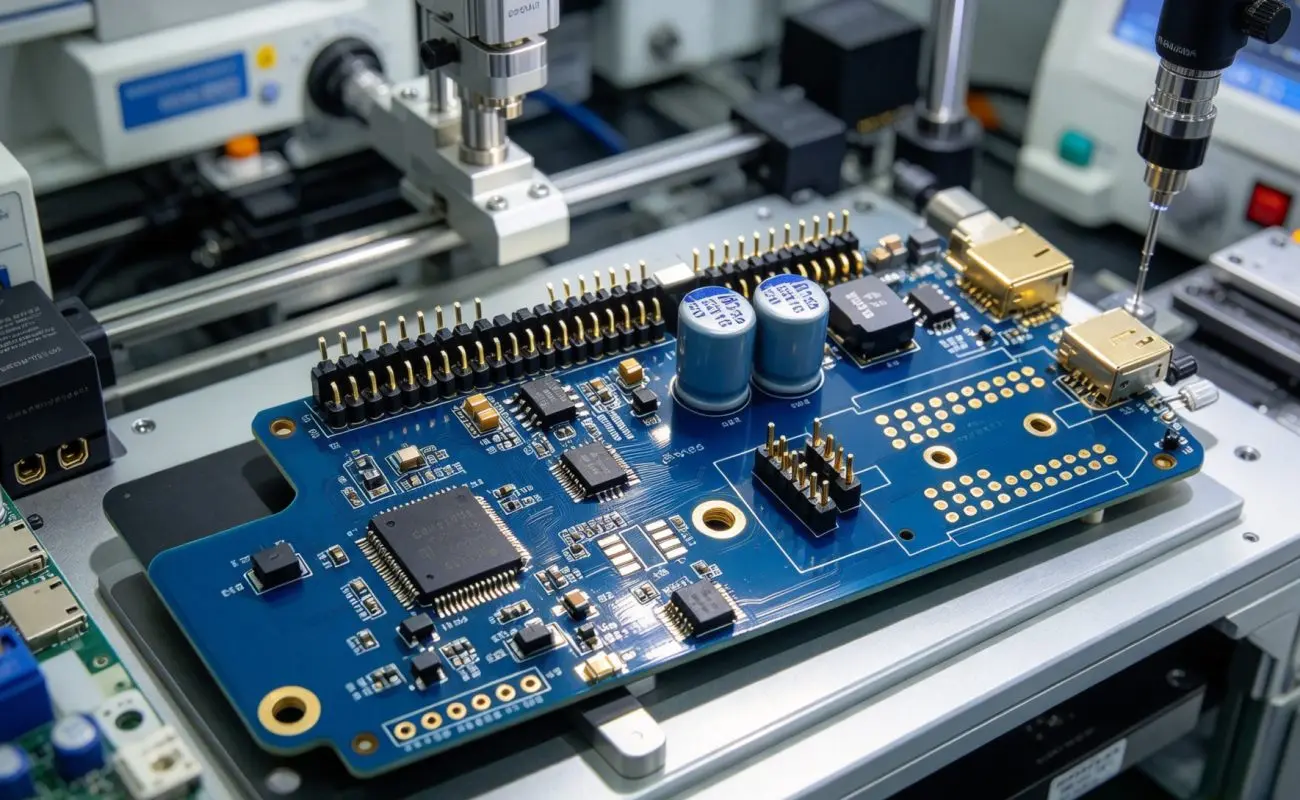
Industrial control systems often operate continuously in environments where stable electrical connections, compact layouts, and consistent assembly quality are essential. Therefore, the surface finish selected for a printed circuit board can have a direct impact on solderability, corrosion protection, and long-term assembly performance. The ENIG surface finish industrial PCBA combines a nickel barrier layer with a thin gold surface, providing a practical finish for industrial electronics that use both SMT and DIP components. For control boards used in automation, communication, sensing, and power management, this surface treatment offers several useful advantages.
1. Improved Corrosion Protection
Industrial equipment can be exposed to humidity, cleaning agents, dust, and other environmental factors that may affect exposed copper surfaces. ENIG uses an electroless nickel layer beneath the gold layer, creating a protective barrier that helps reduce copper corrosion. As a result, exposed contact areas can maintain a more stable surface during storage, assembly, and operation. This makes ENIG particularly suitable for industrial PCBs where consistent surface condition is important.
The protection provided by the finish can be especially useful in applications involving:
- Moderate humidity or temperature fluctuations
- Industrial cleaning and maintenance processes
- Long-term component storage before assembly
- Equipment installed in manufacturing environments
2. Reliable Soldering for SMT and DIP Components
Modern industrial control boards often combine compact surface-mounted components with larger through-hole components. The ENIG surface provides a relatively uniform solderable surface, allowing it to support both SMT and DIP assembly requirements. Consequently, engineers can use small passive components, QFP or BGA packages, connectors, terminal blocks, and relays on the same board according to the application. This flexibility is valuable when a single PCBA needs to balance component density with robust field connections.
| ENIG Benefit | Assembly Impact | Industrial Application |
|---|---|---|
| Uniform gold surface | Supports consistent soldering | SMT components |
| Nickel barrier layer | Protects exposed copper | Industrial control boards |
| Good solderability | Supports component assembly | SMT and DIP production |
| Surface stability | Helps during storage and assembly | Long-term projects |
| Corrosion protection | Reduces surface degradation | Industrial environments |
3. Better Surface Stability During Storage
Industrial electronics may not always move directly from PCB production to final equipment assembly. Boards can remain in inventory while components, cabinets, or other parts are prepared for production. During this period, surface stability becomes an important consideration because oxidation or contamination can affect subsequent soldering. The ENIG surface finish industrial PCBA provides a protected surface that helps maintain solderability during storage when appropriate handling and environmental controls are maintained. Furthermore, this characteristic can simplify procurement planning for manufacturers that manage scheduled production or replacement components. Instead of treating every PCB as an immediate-use item, manufacturers can maintain appropriate inventory according to their production requirements. As a result, ENIG can be a practical option for projects that involve staged assembly and longer supply cycles.
4. Supports High-Density Industrial PCB Layouts
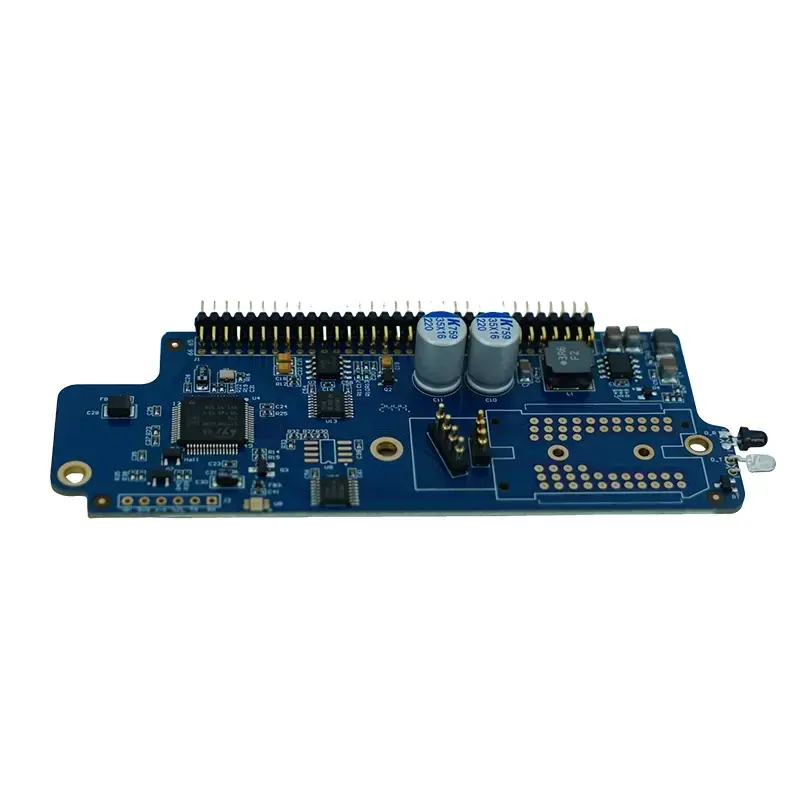
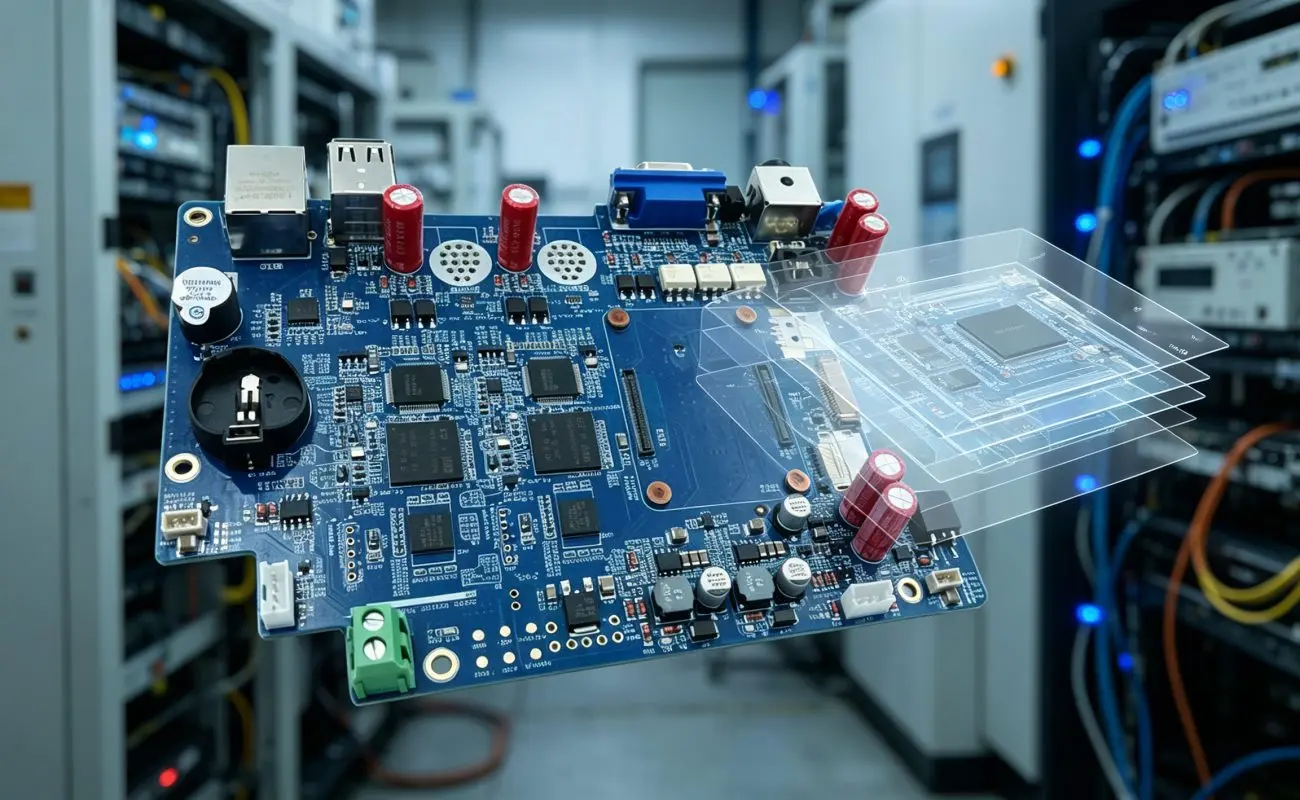
Industrial control electronics increasingly require more functionality within smaller enclosures. The 4-layer FR4 structure in this PCBA provides two signal layers and two power/ground planes, allowing designers to organize signals and power more effectively. In addition, the internal planes can help separate power domains such as 5V and 3.3V while supporting improved EMI management. The board measures 107.03 × 42.80 mm with a 1.6 mm thickness, creating a compact platform for microcontrollers, communication interfaces, and power management components. Moreover, 1 oz copper supports moderate current requirements, while the multilayer structure provides additional routing flexibility compared with a basic two-layer design. Therefore, the combination of multilayer construction and ENIG finishing can support compact industrial control designs without treating surface finish as an isolated feature.
5. Suitable for Diverse Industrial Control Applications
The ENIG surface finish industrial PCBA can be used across several industrial electronics applications where compact design, reliable assembly, and organized signal distribution are important. For example, industrial IoT sensor boards can combine temperature or humidity sensing with wireless communication and data processing. Similarly, motor control modules can manage low-voltage motors using PWM control and current sensing, while communication gateways can support protocol conversion between industrial interfaces. Other potential applications include portable test equipment used for on-site diagnostics. In these cases, the board may need to combine communication, processing, sensing, and power functions within a limited enclosure. Consequently, the combination of a 4-layer architecture, FR4 construction, mixed SMT+DIP assembly, and ENIG surface treatment provides a flexible foundation for different industrial control designs.
How ENIG Fits into the Overall PCBA Design
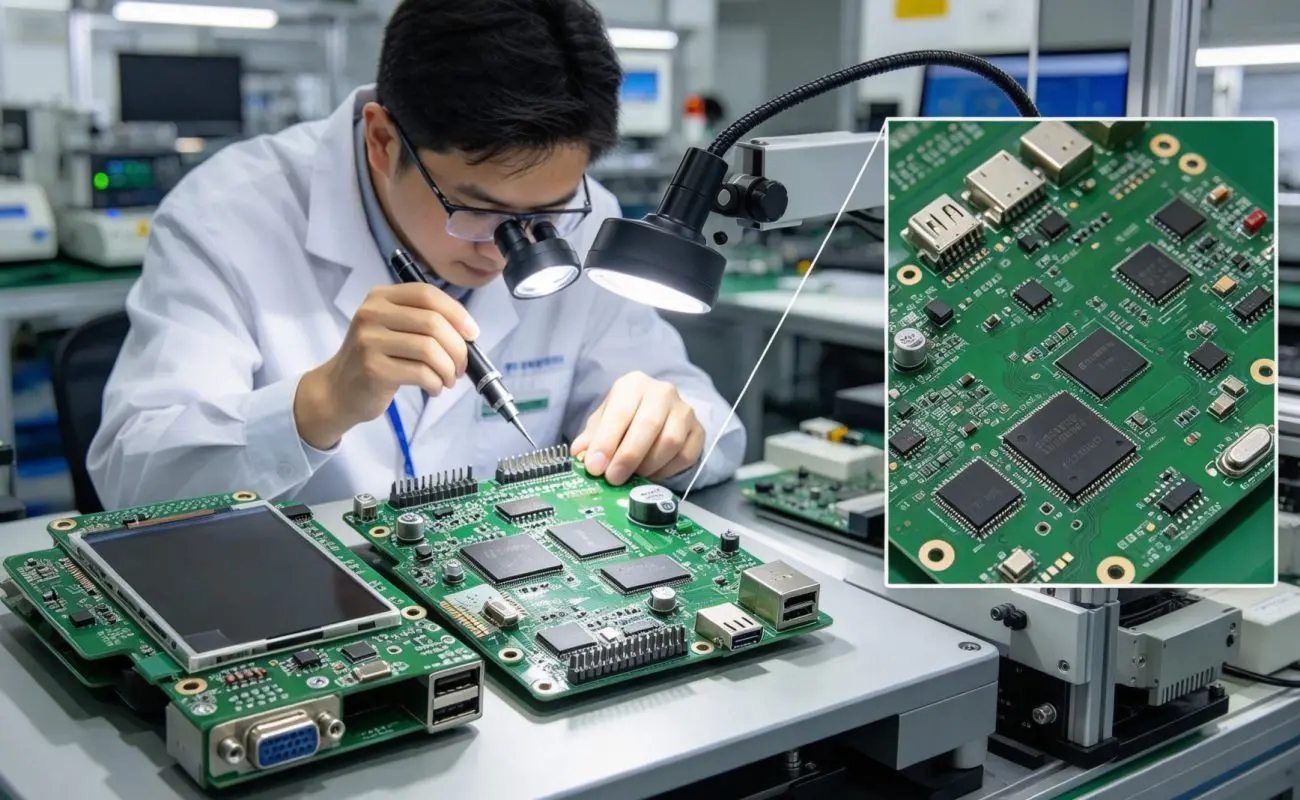
Although ENIG provides important surface-level benefits, the overall performance of an industrial PCBA depends on multiple manufacturing and design factors. The board also uses a blue LPI solder mask, precision fabrication, controlled copper plating, and automated inspection to support consistent production. AOI checks visible assembly conditions, while flying probe testing verifies electrical continuity and isolation. In addition, thermal cycling from -40°C to +85°C can be used to evaluate performance under repeated temperature changes. Fully Hong can support industrial PCBA requirements involving multilayer PCB fabrication, component assembly, and quality inspection. By considering surface finish together with layer architecture, component selection, routing, and testing requirements, manufacturers can develop boards that better match their specific industrial applications.
Choosing ENIG for Industrial Control Projects
Selecting a PCB surface finish should be based on the board’s assembly method, component requirements, storage conditions, and operating environment. ENIG offers corrosion protection, a stable solderable surface, and compatibility with both SMT and DIP components, making it suitable for many industrial control applications. Meanwhile, the 4-layer FR4 construction provides additional space for signal and power organization within a compact 107.03 × 42.80 mm board.
Overall, the ENIG surface finish industrial PCBA combines a protected solderable surface with a multilayer FR4 architecture designed for compact industrial electronics. Its ENIG finish, blue LPI solder mask, mixed assembly capability, and controlled testing process make it suitable for applications ranging from industrial IoT sensors to motor controllers and communication gateways. Therefore, when surface stability, assembly flexibility, and compact circuit design are all important, ENIG can be a practical surface-finish option for industrial PCBA projects.



Leave a reply