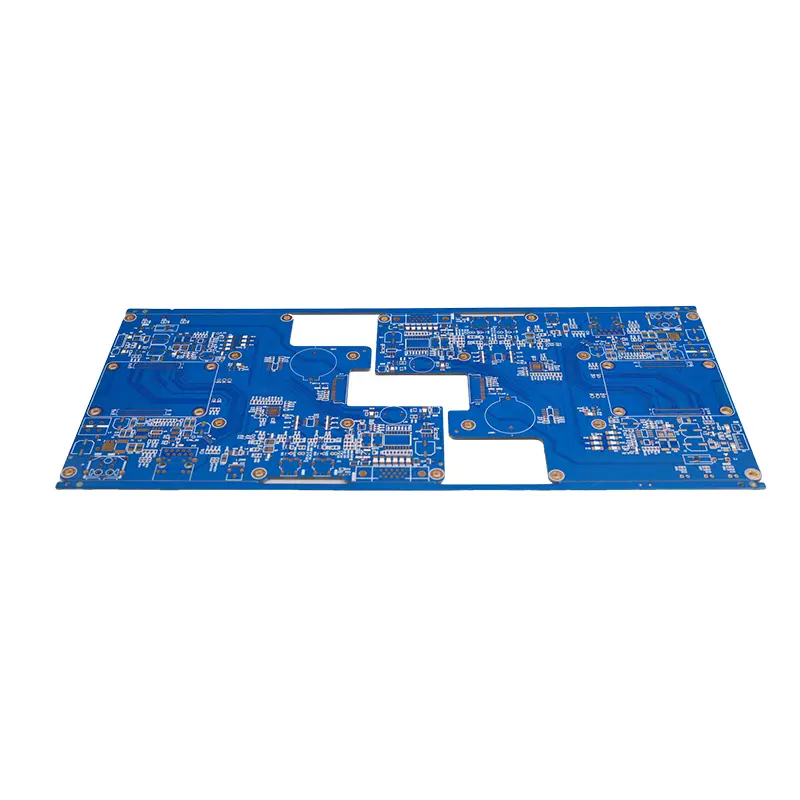
This 4-layer FR4 TG170 PCB delivers high reliability for automotive electronics. Moreover, IATF16949 certification guarantees strict quality standards. The PCB supports applications from advanced driver-assistance systems (ADAS) to in-vehicle infotainment and powertrain control. Additionally, it combines thermal stability, signal integrity, and mechanical robustness, allowing engineers to deploy it confidently in harsh automotive environments.
1. Thermal Stability & Material Excellence
We construct this PCB from FR4 material with a glass transition temperature (Tg) of 170°C, which allows it to outperform standard FR4 (Tg 130°C) in high-temperature conditions. It is suitable for under-the-hood installations and prolonged operation in extreme climates. Furthermore, the 1.6mm thickness provides mechanical rigidity to resist vehicle vibrations (5–500Hz) and shocks. In addition, the 1OZ (35μm) copper on all layers carries currents up to 8A per trace. Thermal vias also support efficient heat dissipation. Consequently, engineers rely on this PCB for motor controllers, battery management systems (BMS), and LED lighting modules.
2. Advanced Surface Finish & Design Features
- ENIG Surface Finish: Electroless Nickel Immersion Gold (ENIG) delivers a 3–5μm nickel barrier to prevent copper corrosion. In addition, a 0.05–0.1μm gold layer ensures superior solderability and wire bonding. Therefore, the PCB maintains long-term reliability for pluggable connectors and fine-pitch components (down to 0.5mm BGA) even in humid or corrosive automotive environments.
- Black LPI Solder Mask: The black solder mask improves component visibility for precise placement and rework. Moreover, it resists UV degradation in sun-exposed areas such as rooftop sensors or exterior lighting modules. Additionally, its chemical resistance protects the PCB from oils, coolants, and other automotive fluids, further extending service life.
- BGA Compatibility & Outline Routing: The PCB supports Ball Grid Array (BGA) components with optimized via-in-pad (VIP) design and laser-drilled microvias. Consequently, solder joints remain void-free, and signal inductance stays minimal. In addition, precision outline routing (±0.1mm tolerance) creates smooth, burr-free edges, allowing seamless integration into custom automotive enclosures.
3. IATF16949-Compliant Manufacturing Process
- Inner Layer Processing: Laser direct imaging (LDI) defines 100μm line/space patterns on 1OZ copper cores. Subsequently, etching forms the signal and power/ground planes. In addition, automated optical inspection (AOI) verifies layer alignment within ±50μm.
- Drilling & Plating: High-precision mechanical drilling creates vias with ±50μm accuracy. Then, electroless and electrolytic copper plating (35μm total thickness) ensures robust through-hole connectivity.
- Surface Finish & Assembly: ENIG plating deposits uniform metal. Additionally, curing the black solder mask at 150°C improves chemical resistance. Furthermore, technicians perform 100% electrical testing for continuity (≤0.1Ω) and isolation (≥100MΩ). X-ray inspection validates BGA via integrity. As a result, X-out panels are strictly rejected to eliminate defects.
4. Automotive Applications & Reliability
- ADAS & Sensor Modules: Engineers integrate radar/lidar sensors, image processors, and IMUs at high density. Moreover, controlled impedance (50Ω ±8%) ensures low-latency signals for real-time safety systems.
- Powertrain Control Units (PCUs): The PCB handles high-current switching (e.g., IGBT drivers) and low-speed control signals. In addition, thermal vias reduce hotspot temperatures by 15°C in power stages.
- In-Vehicle Infotainment (IVI): Engineers integrate touchscreen controllers, audio processors, and wireless modules seamlessly. Furthermore, EMI suppression is active through the 4-layer stackup (2 signal layers + 2 ground/power planes).
- Telematics & Connectivity: The PCB supports 5G/CAN/LIN modules. Consequently, reliable OTA updates and V2X communication are ensured.
5. Quality Assurance & Compliance
- IATF16949 Certification: Our manufacturing facility follows strict automotive quality management systems. Moreover, engineers ensure material traceability (RoHS-compliant copper, lead-free ENIG) and process consistency.
- Environmental Testing: Thermal cycling (-40°C to +85°C, 1,000 cycles) and humidity testing (85% RH, 1,000 hours) validate PCB resilience in automotive conditions.
By combining TG170 thermal performance, ENIG reliability, and IATF16949 compliance, this 4-layer PCB delivers a cost-effective, high-performance solution for mid-complexity automotive electronics. Additionally, its balance of density, thermal management, and signal integrity makes it essential for OEMs and Tier 1 suppliers developing smart, safe, and connected vehicles. Furthermore, whether used in ADAS, powertrain controls, or infotainment systems, this FR4 TG170 PCB provides dependable performance for mission-critical automotive applications.