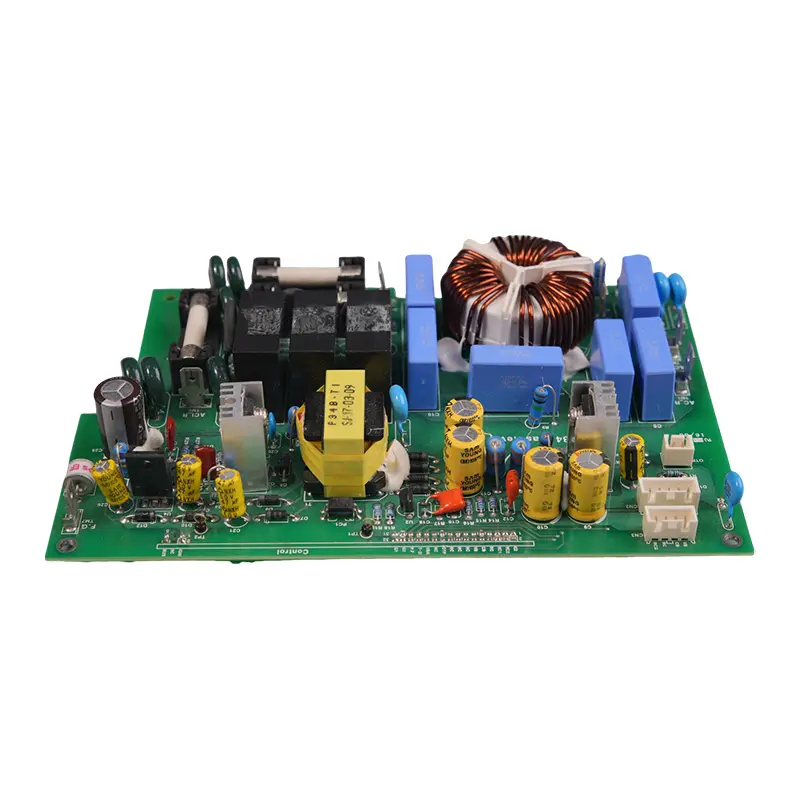
This 4-layer Tg150 PCBA from our printed circuit board manufacturing line provides a tailored solution for power supply applications. Moreover, it combines advanced thermal management, high-efficiency energy conversion, and reliable performance. Our printed circuit board manufacturing process ensures industrial-grade quality for server PSUs, renewable energy inverters, and other power-critical applications. Additionally, the PCBA uses a 4-layer FR4 PCB with a glass transition temperature (Tg) of 150°C. This design withstands moderate heat from power components, ensuring stable operation up to 80°C. Furthermore, integrating a customized transformer allows precise voltage regulation and optimized power transfer. As a result, engineers choose this solution for high efficiency and low electromagnetic interference (EMI) requirements.
Core Design & Thermal Management
The 4-layer architecture separates power and signal domains, which minimizes cross-interference.
- Layer Stackup: We use 2 signal layers and 2 power/ground planes with 1OZ copper on all layers. Consequently, the PCB balances conductivity (up to 8A per wide trace) and EMI suppression.
- Tg150 FR4 Material: This material offers higher thermal stability than standard FR4 (Tg130°C) and reduces delamination risk in power-dense areas like transformer and MOSFET zones.
- Thermal Vias: Strategically placed vias under power components enhance heat dissipation and lower hotspot temperatures by 10–15°C compared to traditional 2-layer designs.
Customized Transformer Advantages
- Tailored Specs: The integrated transformer supports configurable voltage ratios (e.g., 1:1, 2:1), power ratings (50W–500W), and frequency ranges (50kHz–1MHz). Engineers apply it in AC-DC adapters and DC-DC converters.
- Efficiency Optimization: Low-core-loss materials (ferrite or nanocrystalline) and precise winding techniques deliver >90% energy transfer efficiency. Consequently, this meets 80 PLUS-certified power supply requirements.
- EMI Suppression: Shielded windings and balanced magnetic design reduce radiated emissions. Moreover, this helps comply with EN 55032/55022 EMI standards for industrial and consumer electronics.
PCBA Manufacturing Process
- Print Paste & SPI: Our stencil printing of lead-free solder paste (SAC305) maintains ±5% volume accuracy. In addition, 3D solder paste inspection (SPI) prevents bridging in fine-pitch components (e.g., 0402 passives, SOICs).
- Pick & Place & Reflow: High-precision placement (±30μm) of SMT components, including power inductors, diodes, and control ICs, is followed by nitrogen-assisted reflow soldering (peak 260°C). Consequently, joints remain void-free.
- AOI & THT: Our engineers inspect components using automated optical inspection (AOI) before through-hole insertion of transformers, connectors, and electrolytic capacitors.
- Wave & Hand Soldering: Lead-free wave soldering (250–260°C) ensures reliable THT joints. Additionally, manual soldering addresses delicate components or rework needs.
- Functional Testing & QA: We perform FG tests to verify voltage regulation (±1%), ripple noise (<100mV), and overcurrent protection response (<50ms). Moreover, X-ray inspection confirms transformer solder joints and hidden vias are correct. First Article Inspection (FAI) includes dimensional checks and RoHS/REACH compliance, while IPC-A-610 Class 2 standards guide every stage.
Quality Control & Reliability
- Key Checkpoints: SPI ensures solder paste variation <10%, preventing open circuits. X-ray inspection validates transformer winding integrity and BGA joint quality. Thermal cycling (-40°C to +85°C, 500 cycles) simulates real-world stress.
- Standards Met: This PCBA meets IEC 62368 (electrical safety), EN 61000 (EMC), and UL 60950 for IT equipment.
Applications
- Industrial Power Supplies: 24V/48V DC supplies for factory automation. Moreover, the transformer’s feedback loop enables active PFC and remote monitoring.
- Server & Data Center PSUs: High-efficiency (≥85%) power modules support 1U/2U servers. Additionally, the transformer’s low-profile design fits space-constrained enclosures.
- Renewable Energy Inverters: DC-AC inverters for solar/wind systems. Furthermore, the transformer ensures galvanic isolation and MPPT control.
- Consumer Electronics: Fast-charging adapters (e.g., USB PD 3.0) provide 65W+ output for laptops and gaming devices.
Lead Time & Customization
- Standard Lead Time: 4–5 weeks, including PCB fabrication, component sourcing, and testing.
- Expedited Service: 2–3 weeks available for urgent projects, depending on transformer customization complexity.
- Design Support: Collaborative design services help optimize transformer specs, layout, and thermal performance for unique power requirements.
By integrating a customized transformer with a robust 4-layer Tg150 PCBA, this solution delivers unmatched reliability and efficiency for power-critical applications. Additionally, our printed circuit board manufacturing ensures precision assembly, rigorous quality control, and flexible design. Consequently, engineers developing next-generation power supplies rely on this PCBA for stable power delivery and long-term operational integrity.