

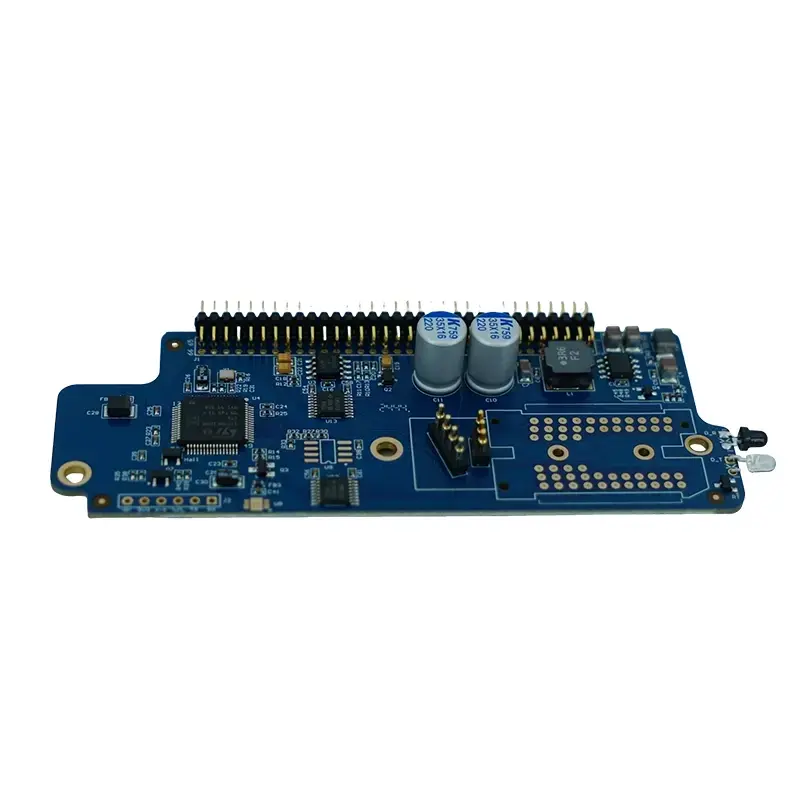
Modern automation equipment often needs to combine multiple functions within a limited installation space. Therefore, circuit boards must provide enough room for controllers, communication interfaces, sensors, and power components without making the overall equipment unnecessarily large. This industrial control pcb uses a compact 107.03 × 42.80mm footprint with a 1.6mm thickness, providing an efficient platform for applications where available PCB space is limited. In addition, the FR4 substrate offers stable electrical insulation and mechanical rigidity, making the board suitable for industrial environments with moderate vibration and temperature fluctuations. Furthermore, the compact structure does not sacrifice functional integration because the four-layer architecture creates dedicated areas for signals, power, and grounding, allowing engineers to organize complex circuits more efficiently.
How the 4-Layer Structure Improves Layout Efficiency
A four-layer PCB provides more routing flexibility than a basic two-layer design. This board uses two signal layers combined with two power and ground planes, so engineers can separate important power and signal paths while maintaining a relatively compact board size. Moreover, the inner layers can be arranged around different power domains, such as 5V and 3.3V, while dedicated ground areas help improve signal return paths and reduce unwanted electromagnetic interference. Consequently, the four-layer structure provides a practical balance between circuit density and electrical performance, making it particularly useful for industrial controllers that combine processing, communication, sensing, and power management functions.
1OZ Copper for Moderate Current Requirements
The industrial control pcb uses 1OZ copper, equivalent to approximately 35μm, which supports moderate current loads and can handle up to 8A per wide trace under suitable design conditions. In addition, copper pours on the power and ground planes help distribute current more effectively while reducing voltage drop and localized thermal hotspots. Therefore, the board can support power management components and other moderately power-intensive circuits while maintaining a compact overall structure. This copper configuration also provides a practical balance between electrical performance, manufacturing requirements, and overall PCB thickness.
FR4 Material for Stable Industrial Operation
Material selection directly affects the mechanical and electrical stability of an industrial PCB. This board uses FR4 material with a dielectric constant of approximately 4.5, providing reliable electrical insulation while maintaining mechanical rigidity. As a result, the PCB can withstand moderate vibration and temperature fluctuations commonly found in industrial control equipment. Furthermore, FR4 provides a familiar and practical foundation for both high-density component placement and through-hole assembly, allowing designers to create compact electronic systems without unnecessarily increasing material complexity.
ENIG Surface Finish for Reliable Connections
Surface treatment is another important consideration for industrial electronics. This PCB uses an ENIG surface finish that combines an electroless nickel layer with a thin immersion gold layer. The nickel layer, approximately 3–5μm thick, helps protect the copper surface against corrosion, while the 0.05–0.1μm gold layer provides a clean and reliable surface for soldering. Consequently, ENIG supports consistent solder joints for both SMT and DIP components, making the surface finish suitable for industrial boards that require stable assembly performance and long-term connection reliability.
Mixed SMT and DIP Assembly Flexibility
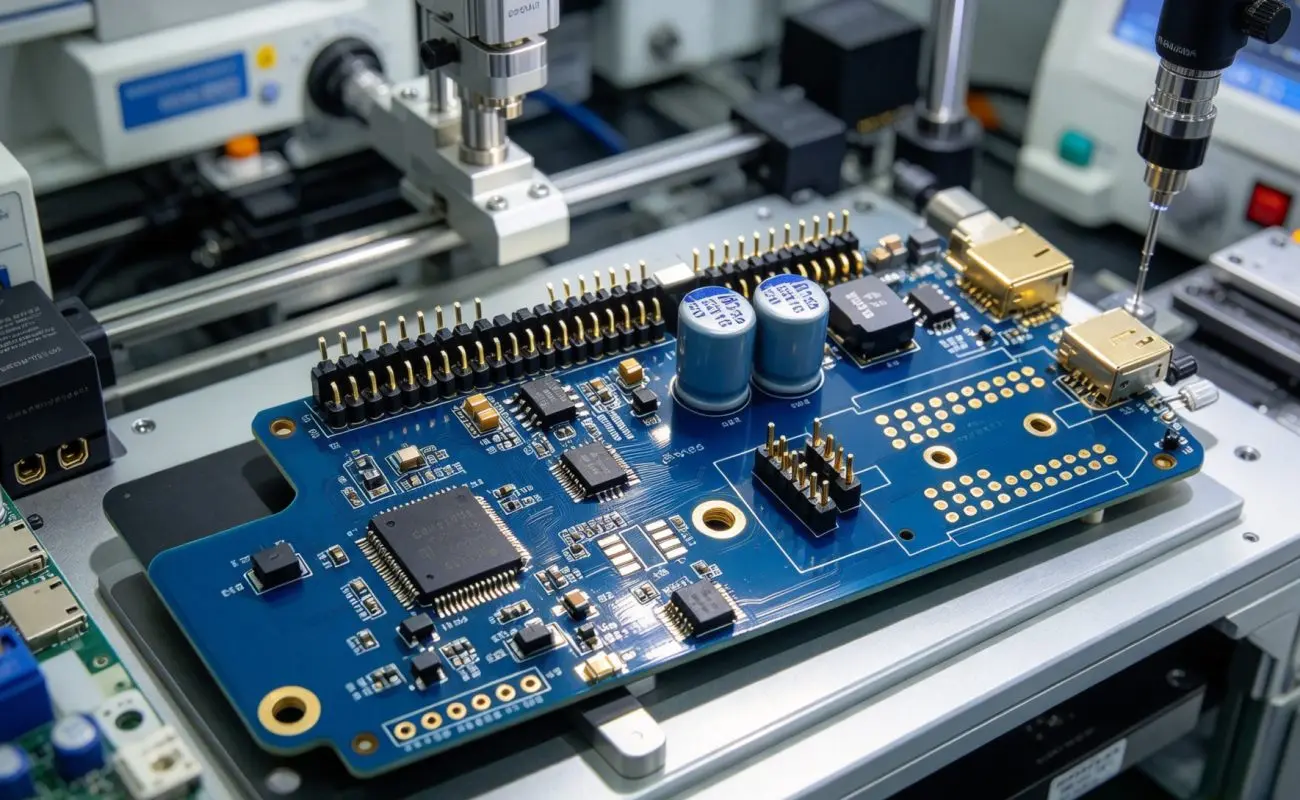
Industrial control equipment often combines compact electronic components with larger connectors and rugged interfaces. Therefore, supporting both SMT and DIP assembly provides greater design flexibility. SMT assembly allows high-density placement of components such as 0201 passive components, QFP ICs, and BGA packages with 0.5mm pitch, while DIP mounting is suitable for larger components such as terminal blocks, RJ45 ports, relays, and other field-wired interfaces. As a result, the board can accommodate both space-saving electronics and mechanically robust connections within the same compact platform, making it easier to integrate different component types into industrial control systems.
Key Design Advantages
The main advantages of this PCB come from the combination of its compact structure, multilayer architecture, material selection, and assembly flexibility. The 107.03 × 42.80mm footprint helps reduce equipment space requirements, while the 1.6mm thickness provides a practical balance between rigidity and installation flexibility. Meanwhile, the four-layer architecture combines two signal layers with two power and ground planes to improve routing efficiency, and the 1OZ copper supports moderate current requirements. In addition, the FR4 substrate provides electrical insulation and mechanical stability, while the ENIG finish supports corrosion resistance and reliable soldering. The blue LPI solder mask further improves visual contrast and provides resistance to common industrial cleaning agents and solvents.
- Compact footprint: 107.03 × 42.80mm for space-efficient equipment design.
- 4-layer stackup: Two signal layers plus two power/ground planes.
- 1OZ copper: Supports moderate current distribution.
- FR4 material: Provides electrical insulation and mechanical rigidity.
- ENIG finish: Helps improve surface protection and solderability.
- SMT + DIP assembly: Supports both compact and rugged components.
- Industrial inspection: Includes AOI and flying probe testing.
- Thermal cycling: Tested from -40°C to +85°C for 500 cycles.
Four-Layer PCB vs. Two-Layer PCB
The choice between two and four layers depends on circuit complexity, available space, signal requirements, and power distribution needs. A two-layer board can be effective for simpler circuits; however, routing becomes more challenging as the number of components and signal paths increases. By comparison, a four-layer design provides additional internal planes for power and grounding, allowing engineers to reduce routing congestion while maintaining better separation between signal and power functions. Therefore, four-layer construction can be a more practical option for compact industrial systems that require multiple functions within a limited PCB area.
| Feature | 2-Layer PCB | 4-Layer PCB |
|---|---|---|
| Routing Space | Limited | Greater |
| Power/Ground Planes | Limited | Dedicated inner planes |
| EMI Management | Application dependent | Improved layout flexibility |
| Circuit Density | Moderate | Higher |
| Compact Design | Suitable for simpler circuits | Better for complex systems |
| Typical Use | Basic control circuits | Industrial control and automation |
Precision Manufacturing for Consistent Results
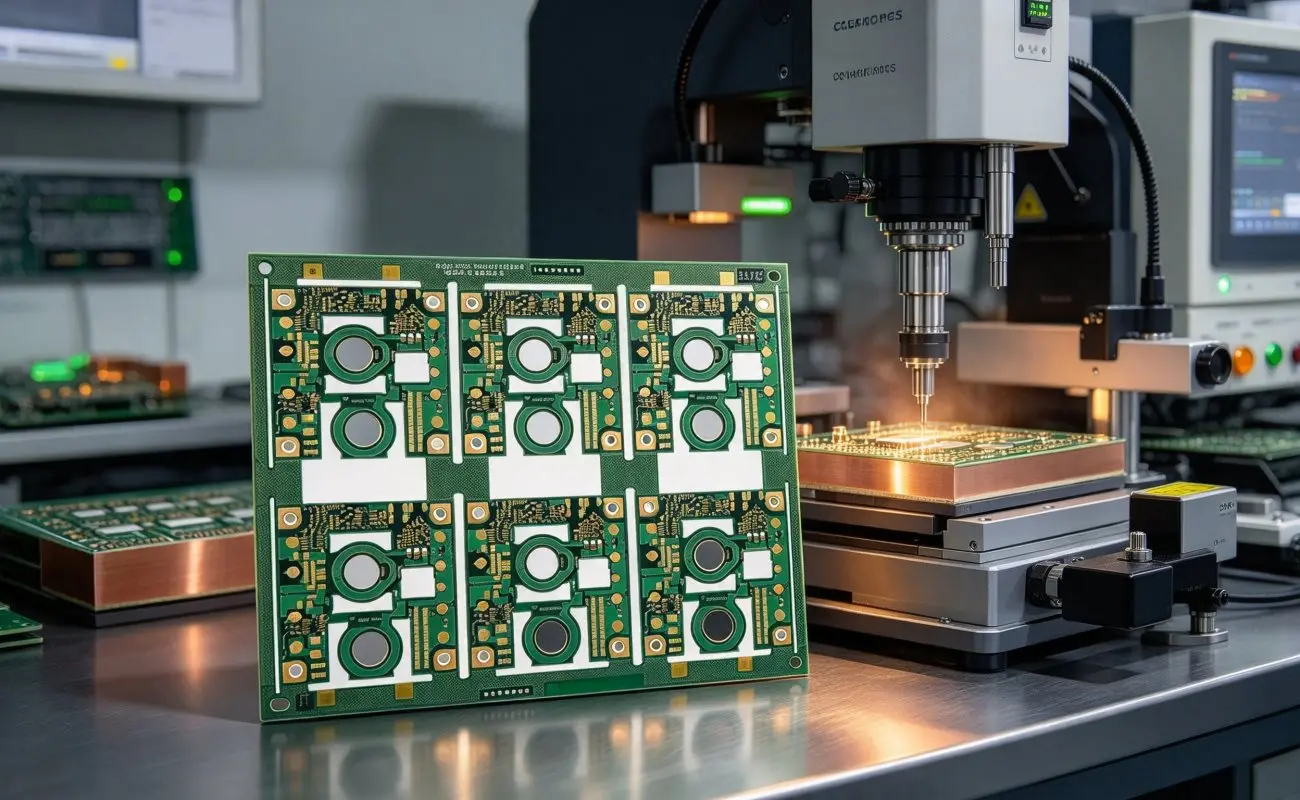
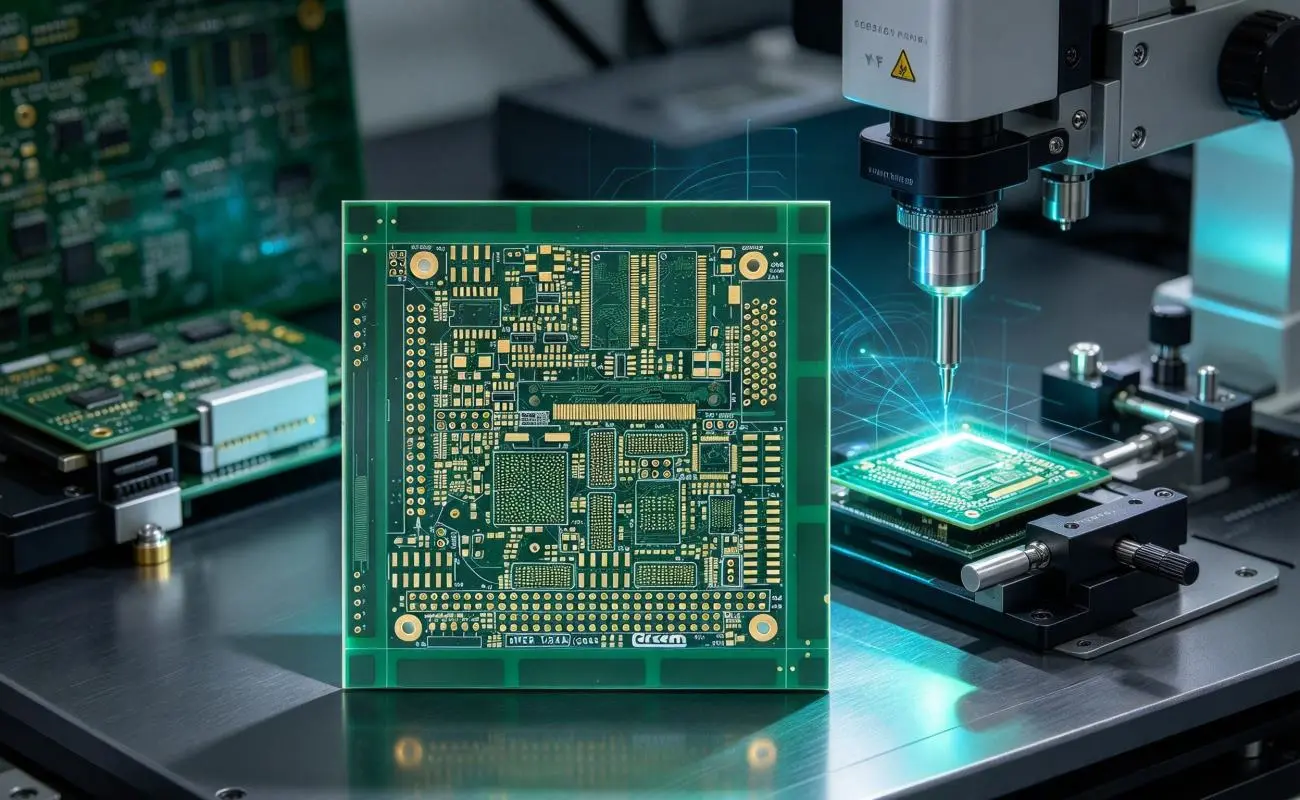
Manufacturing accuracy is essential when producing compact multilayer PCBs. This board uses laser direct imaging to achieve approximately 75μm line/space accuracy for signal traces, while electrolytic copper plating provides uniform copper thickness across the layers. In addition, 100% automated optical inspection checks solder mask coverage and silkscreen quality, while flying probe testing verifies electrical continuity and isolation. Furthermore, thermal cycling from -40°C to +85°C over 500 cycles helps evaluate the board under repeated temperature changes. These processes work together to support consistent manufacturing quality and stable electrical performance.
Applications in Industrial Automation
The industrial control pcb is suitable for a range of automation and control applications. In industrial IoT sensors, it can integrate temperature and humidity sensors, wireless communication modules, and processing circuits within a compact enclosure. For motor control modules, the board can support PWM control, current sensing, and low-voltage motor management, while communication gateways can use the board for protocol conversion such as RS-485 to Ethernet. In addition, the compact dimensions make the PCB suitable for portable test equipment and on-site diagnostic devices. Therefore, its four-layer structure provides flexibility across several industrial applications while helping equipment designers optimize internal space.
Reliable Performance for Smart Factory Equipment
Smart factory systems often require multiple electronic functions within a small control unit, including communication, sensing, processing, and power management. The four-layer stackup helps organize these functions by providing dedicated signal and power/ground layers, while the compact board dimensions allow designers to optimize enclosure space. Moreover, the combination of ENIG surface treatment, 1OZ copper, and FR4 material supports stable operation for industrial electronic assemblies. As a result, the board offers a practical solution for automation equipment where compact construction, electrical organization, and dependable performance must work together.
Why Choose Fully Hong?
Fully Hong provides PCB solutions designed around practical industrial electronics requirements. This four-layer FR4 PCB combines a compact footprint, dedicated power and ground planes, 1OZ copper, ENIG surface treatment, and mixed SMT+DIP assembly capability. Furthermore, precision fabrication and comprehensive inspection help support consistent manufacturing quality. With IPC-6012 Class 2 compliance and RoHS/REACH requirements, the board is designed for applications where compact construction, stable performance, and dependable assembly are important.
Conclusion
A compact PCB does not have to compromise circuit functionality. By combining two signal layers with two power and ground planes, this four-layer design creates additional routing space while maintaining a compact 107.03 × 42.80mm footprint. The industrial control pcb also combines 1OZ copper, FR4 material, ENIG surface treatment, and flexible SMT+DIP assembly, making it suitable for industrial IoT sensors, motor controllers, communication gateways, and portable diagnostic equipment. Ultimately, the four-layer architecture provides a practical balance between size, routing flexibility, power distribution, and reliability, making it a strong option for modern industrial control and automation systems.




Leave a reply